
The Feeling Is The Product
By Ronan Ryle ·
The short answer
When anyone can make a beautiful picture with AI, the photo stops being what people pay for. The feeling is the product. Difference Makers build an experience that brings out real emotion, then deliver the photograph ready for display, such as a Saporito Collection of artwork displayed in their home or a 3XM Window Folio Box on display, so the feeling comes back every time it’s seen.
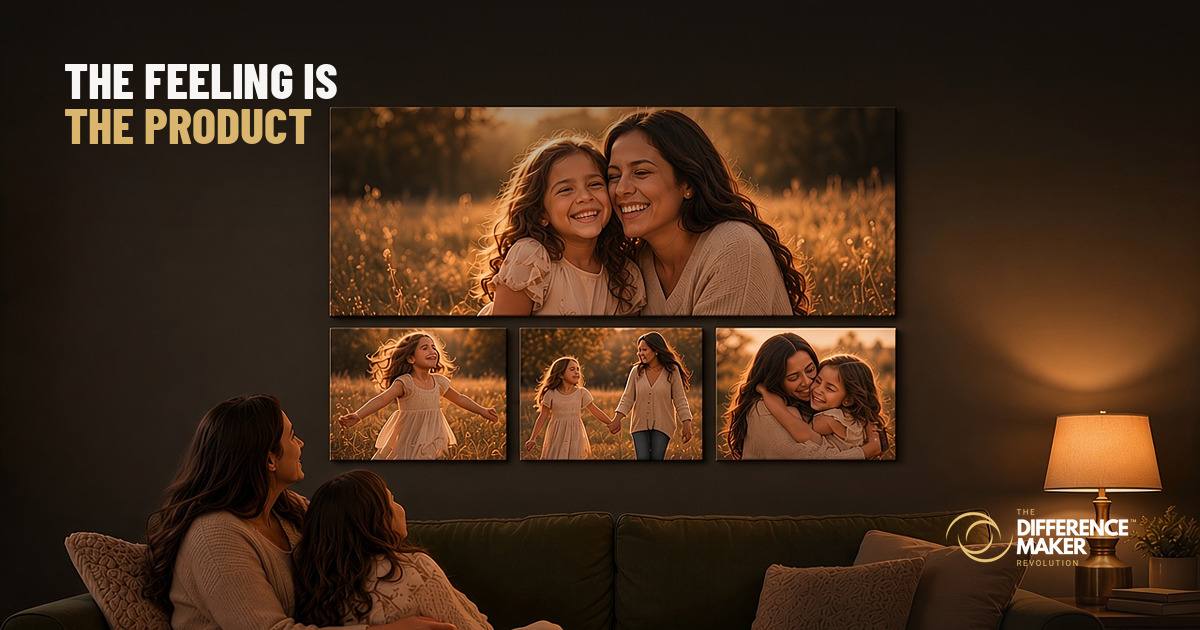
When anyone can make a beautiful picture with AI, the photo stops being the thing people pay for. The feeling is the product. Difference Makers charge for how their clients feel, and they deliver that feeling in a form that brings it back every time the photograph is seen.
That’s the whole idea. The rest of this post is about why it matters now, and what to do about it this week.
What does “the feeling is the product” mean?
I’ve spent decades in business alongside the photography industry. What I see across the whole of it is this: the feeling is the product, but it’s often misunderstood by photographers.
It’s easy to see why. You’re a portrait or wedding photographer. You value photography, and so do the photographers you spend time with. You notice the light, the lens and the edit.
But your clients aren’t photographers.
Whether someone buys a designer handbag or saves money at a discount store, the choice comes down to how it makes them feel. Your clients are no different. They don’t pay for a file. They pay to feel seen, proud, close to the people they love. The photograph is how that feeling comes home with them.
Your art still matters. It’s the foundation. But what people buy is the feeling.
Why does AI make the feeling matter more?
AI can now make a beautiful picture in seconds. If you make your business about photos, AI will take you out. It’s quicker, it never sleeps and it doesn’t charge what you charge.
So stop competing on the thing a machine can copy.
AI can’t sit with a mum and hear why this year matters. It can’t make a nervous dad laugh until he forgets the camera is there. It can’t hand a family a photograph of themselves and watch their faces change.
That human part is yours. It’s the one thing AI can never replace, and it’s what your clients will pay for, as long as you make it the product.
Why does a photograph on display keep its value?
Think about where photographs end up.
A file on a phone gets buried, and after a while nobody can find it. A loose print goes in a drawer, with the best of intentions, and rarely comes out again. Even a beautiful album often gets put away on a shelf, opened once in a while and then forgotten.
A photograph on display is different. It brings that feeling back every time someone walks past it. Every morning on the way out the door. Every evening on the stairs. Every time a grandparent visits.
That’s why display matters so much. The value isn’t in owning the photograph. It’s in seeing it, again and again, and feeling something each time.
People love convenience. If they get a file they have to print, frame or mount themselves, it usually doesn’t happen. If you hand them artwork that’s ready to live with, like a Saporito Collection designed to be displayed above their sofa, it’s far more likely to end up displayed.
And a Saporito Collection isn’t the only way to keep the feeling displayed. A 3XM Window Folio Box is designed to stand on display on a sideboard or table, with a favourite photograph in the window. Your client can change that photograph in seconds, so the box becomes a rotating work of art, and the feeling stays on display.
What does it mean to deconstruct the value?
If you photograph portraits and weddings, this is the lesson I’d pass on to you above all: don’t deconstruct the value.
Deconstructing is when you strip your offer back to the bare minimum. Files only. No display. No experience. Just the download.
On a spreadsheet, digital only can look attractive. Viewed as an accountant, it’s tidy. But it turns what you do into a commodity, and once something is a commodity, it’s a slippery road. Your clients start comparing you on cost, and a machine will always win that race.
Pricing also comes from confidence in the value you deliver. If you wouldn’t pay somebody for what you do, why would anybody pay you? Believe in the feeling you create, and you’ll stop giving it away in pieces.
How do you bring out the feeling before the camera comes out?
The feeling starts long before anyone stands in front of you. Here’s where Difference Makers begin.
- Understand the feeling they secretly want. Get to know what your client truly wants to feel, even if they’d never say it out loud. Then design the whole experience around creating work that brings that feeling back every single day.
- Ask where the feeling will be displayed. Don’t make it about the artwork. Make it about the feeling it creates, and where in their home they want to feel it every day. This plants the idea of display from the very first conversation.
- Plan the experience around them. Use what they told you to shape the day: the place, the pace, the people who need to be there. Make it about them, not about your art.
- Make room for real emotion. Give people time to settle, to laugh, to hold each other. The best photographs come when they forget about the camera.
When your clients feel valued and connected during the experience, the photographs become a reminder of that feeling. That’s what makes you irreplaceable.
What should you deliver so the feeling keeps coming back?
Build your offer around display, and keep the value whole.
- A Saporito Collection, displayed in their home. One story told in artwork, sized to sit balanced above a sofa, dining table or staircase, with no extra step for your client.
- A 3XM Window Folio Box that stays on display. It stands on a sideboard or table with a favourite photograph in the window, and that photograph can be changed in seconds. A rotating work of art, so the feeling stays on display.
- The social media file, bundled with them. Don’t sell the file as a separate, stripped-back option. Include it with what they buy, so sharing becomes part of the feeling, not a replacement for it.
- Show it on display. In your Design Consultation, show the photographs the way they’ll be lived with, not as files on a screen.
Make the real thing more appealing to buy, and a copied preview can’t compete.
Where do Difference Makers go from here?
Being the photographer your clients can’t replace isn’t about fighting AI. It’s about doubling down on what makes you human, and making sure your clients feel it every day.
If you’d like help putting this into practice, join Steve Saporito, Jeanine McLeod and me at our free Inner Circle Launch Meet Up on Tuesday 1 December: 5pm Ireland & UK · 12 noon US Eastern · 9am US Pacific. It’s 90 minutes, live on Zoom, with practical, human-focused ways to stay irreplaceable as AI changes how people find and book. Bring your questions. There’s no replay, so the only way to get it is to be there.
And if you can’t make it, our free monthly webinar is always a good place to start.
Frequently asked questions
What should photographers charge for when AI can make beautiful pictures?
Charge for the feeling, not the photo. AI can produce a nice picture, but it can’t create the experience, the connection or the emotion your clients feel. Make that the product, and deliver it in a form they’ll see every day.
Why is a displayed photograph worth more than a digital file?
A photograph on display brings the feeling back every time someone sees it. A file on a phone gets buried and a print in a drawer is rarely taken out, so their value quietly fades.
Should photographers offer digital files only?
Digital only can look tidy on a spreadsheet, but it deconstructs the value and turns what you do into a commodity. A better approach is to bundle the social media file with display products, such as a Saporito Collection of artwork displayed in their home and a 3XM Window Folio Box that keeps a favourite photograph on display.
How can a photographer create more emotion for clients?
Start before the camera comes out. Get to know what your client secretly wants to feel and where they want that feeling displayed, design the experience around it, and give people time to relax and connect on the day.